
Read review excerpts, quotes and impressions from Ruth Asawa: Retrospective at SFMoma.
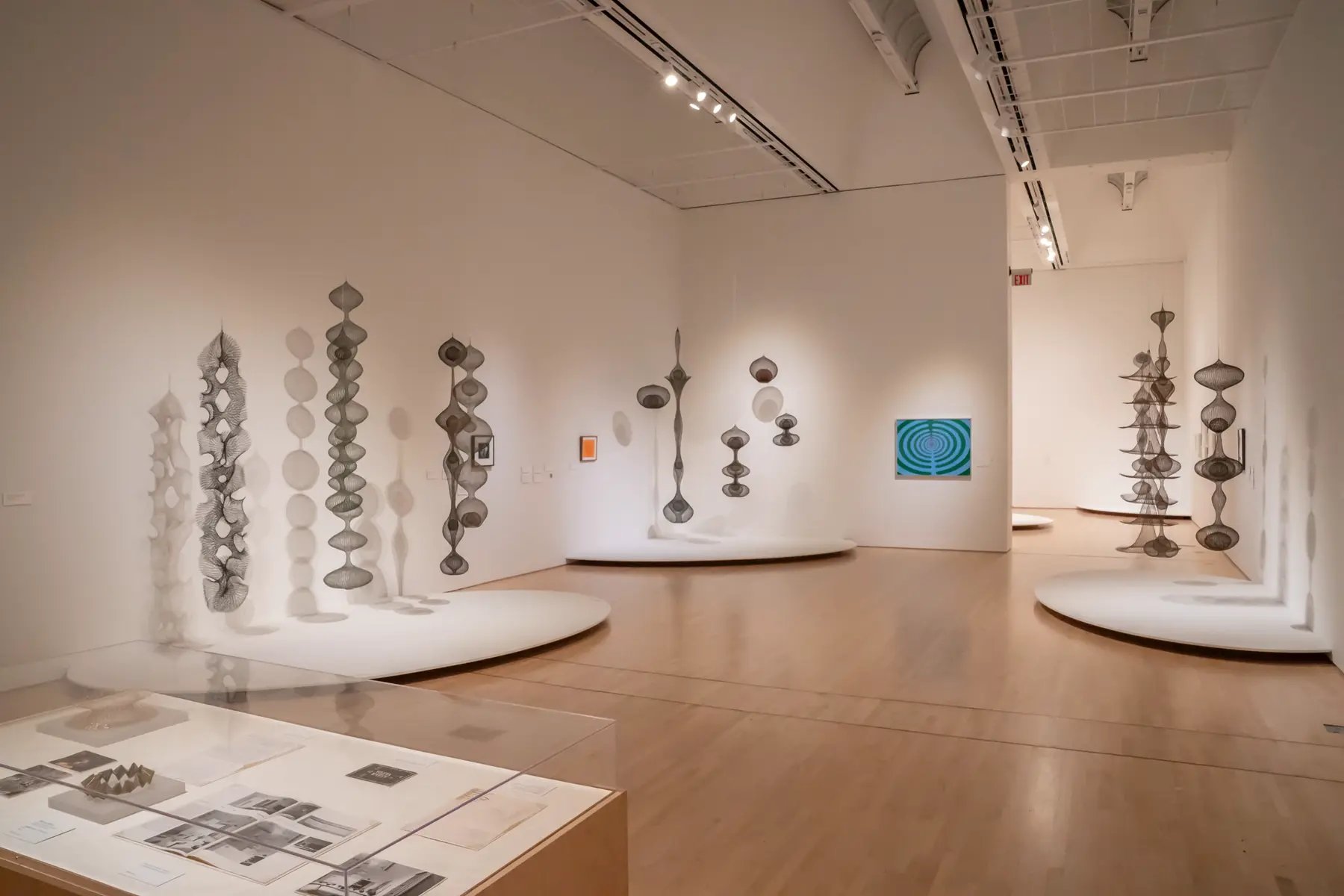
Installation view of Ruth Asawa: Retrospective at the San Francisco Museum of Modern Art, California, 2025. Photo by Adam Stanzak.
Artwork © 2025 Ruth Asawa Lanier, Inc., Courtesy David Zwirner
“Asawa’s influence is so vast, and her artistic output so varied, that it takes 12 galleries at the San Francisco Museum of Modern Art to honor that legacy. Ruth Asawa is the artist’s first posthumous retrospective, and it goes big, covering six decades of artmaking, with over 300 works on the museum’s fourth floor.”
“Arranged chronologically and thematically, the show won’t disappoint fans of Asawa’s hanging looped-wire sculptures. By my count, there are nearly 60 of those airy pieces in this show. But co-curators Janet Bishop (of SFMOMA) and Cara Manes (of MoMA, the touring exhibition’s next stop) also focus on bodies of work I was far less familiar with: early abstract paintings, branching tied-wire sculptures and intricate ink drawings of bouquets.
“While her looped-wire forms are circular and self-contained, these pieces are open-ended bursts of ever-diminishing branches of wire. Think tumbleweed, root structure, fractal, snowflake under a microscope. The spiky sculptures impressively range in size, some of their tips dotted with glimmering drops of resin … They curve in on themselves, blending different types of metal and suspending forms within forms organically, almost magically. The installation at SFMOMA is stellar, with shadows given almost as much space as the art.”

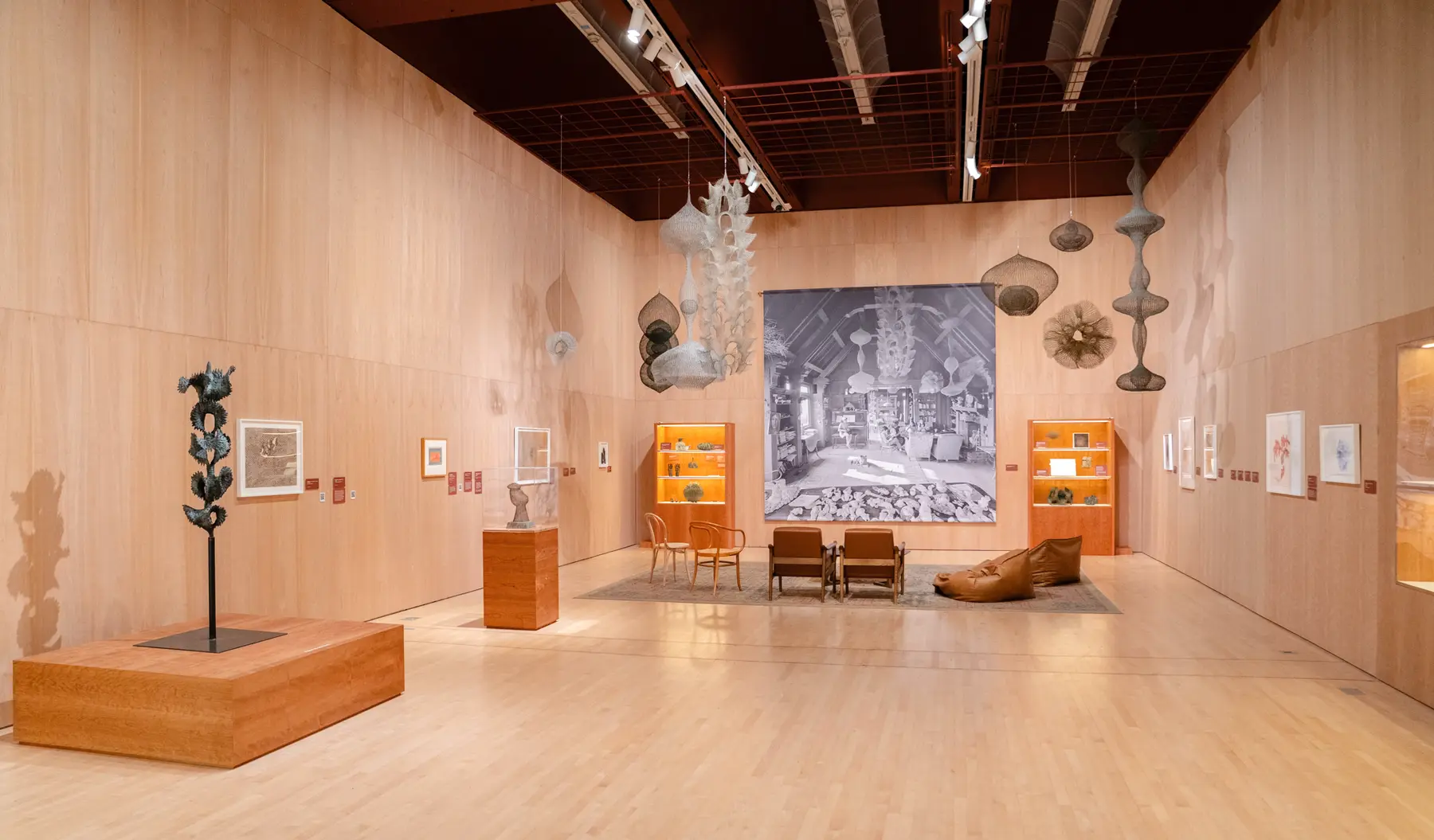
Installation view of Ruth Asawa: Retrospective at SFMOMA, California, 2025. Photo by Adam Stanzak
Artwork © 2025 Ruth Asawa Lanier, Inc., Courtesy David Zwirner
At the exhibition’s center, a large gallery lined with warm wood panels cozily nods to Asawa’s Noe Valley living room, which was filled with her own art, friends’ work and the comings and goings of her family of eight. It’s a nexus, a hub. In 1962, whether knowingly or not, she began to illustrate that concept through tied-wire sculptures.
Even as she developed new ways of making sculptural forms, Asawa was using the humblest of materials in tried-and-true ways. Some of my favorite pieces in the show are stamped ink on paper, repeated shapes of cut apples, potatoes and even a bike pedal. To Asawa, art could be informed by — and physically made from — just about anything in everyday life: fruits and vegetables, flowers, a sleeping child, bentwood cane chairs, a shingled house.
The exhibition’s final galleries are given over to a staggering number of works on paper, most of them delicate drawings of flowers, documentation of bouquets given to Asawa by friends and family. Her elegant, exacting lines trace petals, stems and leaves, making permanent these ephemeral, soon-to-be-wilted arrangements.”
“This is the Ruth Asawa I like to picture: the busy, prolific patron saint of San Francisco arts. This is what an experiment-driven, rigorous, collaborative and deeply generous art practice looks like — and what Ruth Asawa captures, in room after room, so well.”
Read more from KQED Arts SFMOMA’s Ruth Asawa Retrospective Honors the Patron Saint of San Francisco Arts, by Sarah Hotchkiss.
Installation view of Ruth Asawa: Retrospective at the San Francisco Museum of Modern Art, California, 2025. Photo by Adam Stanzak.
Artwork © 2025 Ruth Asawa Lanier, Inc., Courtesy David Zwirner
“There’s a moment in ‘Ruth Asawa: Retrospective’ that feels overwhelming for any admirer of the San Francisco artist.
Turning the corner in the fourth-floor galleries, there is a space designed to evoke the living room of Asawa’s Noe Valley home, where she lived with her husband, architect Albert Lanier, and their six children, from 1961 until her death. The aged wood and a sense of lived-in warmth places visitors in the center of Asawa’s work as an artist, mother and arts education advocate. The house, where Asawa also kept her studio, was a center of family, community and her arts education advocacy. Several of those same sculptues now hang above visitors in the gallery, high enough that you can walk under and stare up into them.”
“It was definitely emotional for everybody. That picture encapsulates my childhood and who my grandmother was.”
— Henry Weverka, Asawa’s grandson and president of Ruth Asawa Lanier Inc.
“‘Ruth Asawa Retrospective’ has been in the works for five years and contains more than 300 objects. It is the (overdue) celebration the artist merits. Asawa (1926-2013) remains an enormous presence in San Francisco, with a large concentration of her numerous public projects in the Bay Area found here. Since her death, there have been multiple smaller shows of her work across the globe.
“Asawa has had this tremendous resurgence, but my aunts, uncles and my mother have been working at this for 65 years now. They were the ones who were helping with her public commissions, coiling wire with her in the 1950s, starting to tell her story long before she passed away.” –Henry Weverka
Asawa spent her childhood in Norwalk (Los Angeles County) the fourth of seven children born to Japanese immigrant farmers. Riding on the back of her father’s tractor, she would drag her feet in the dirt and watch the curved, symmetrical shapes they would make in the dust. Asawa’s daughter Aiko Cuneo said that farm life was one of the experiences that gave Asawa the discipline and work ethic that became central to her art.
In 1942, Asawa and her family were incarcerated by the United States as part of Executive Order 9066, the Japanese internment policy during World War II. Her family was taken to a camp in Rohwer, Ark., but her father was separated from the family and taken to a different camp. To have this exhibition mounted now, as the government again forcibly removes immigrants and their families from their homes is a dark parallel that hangs in the air like one of Asawa’s sculptures. But it’s also a show filled with beauty, and Asawa’s life is a testimony to the triumph of hope and creativity over fear and division.
‘Retrospective’ begins by tracing Asawa’s time at Black Mountain College in North Carolina following her incarceration where she studied with Josef Albers, was mentored by his wife textile and printmaker Anni Albers, and was taught by geodesic dome pioneer Buckminster Fuller (who designed Asawa’s sterling silver river rock wedding ring, which is on view). Learn more about her time at Black Mountain College >
Asawa’s early fascination with repetition is on display in her “Meandering” drawings, and the organic shapes that would define her sculptures, most notably on an untitled 1948-49 cut paper on plywood work. There’s also her earliest experiments with wire using the basketmaking technique she learned on a 1947 trip to Mexico, beginning with the looped wire basket in which the Albers kept their mail from 1948-49.
“Her experience at Black Mountain was profound. There were so many ways in which it clicked for her, tapping into her natural resourcefulness and openness to using any sorts of materials” –Curator Janet Bishop
In 1949, Asawa married fellow Black Mountain College student Lanier in San Francisco, and the 1950s began one of the most productive periods of her life. She not only gave birth to four of the family’s six children (two are adopted), but she also began creating the hanging looped wire sculptures that are among her signatures.
“The galleries with suspended works from that same era feel like walking under the sea amid kelp and creatures of the deep. To see so many of these sculptures at once shows the variety of shape, color wire (from black to copper and gold) as well as the repetition of motifs.”
Explorations of Asawa’s public commissions also feature in the show, including the famed “San Francisco Fountain” in Union Square from 1973, with figures formed in baker’s clay by Asawa and students from the Alvarado School Arts Workshop then cast in bronze (a touchable test panel is on display), and the nursing mermaid “Andrea’s Fountain” from 1968 in Ghirardelli Square.
Listen to stories from Asawa’s family and friends about her public art in the San Francisco Bay Area >
The connections to Asawa’s arts education advocacy and motherhood are easily apparent. Some of Asawa’s bronze and clay masks of friends and family members are on display, along with casts of Weverka’s hands and feet.
A garden on a terrace overlooking Third Street is meant to remind people of the importance of Lanier and Asawa’s Noe Valley garden as part of her work, and it sets the stage for the wall mounted and standing tied wire sculptures that echo branches, trees and flowers. Likewise, Asawa’s watercolors of fruit, vegetables and flowers, and the botanical drawings from the last decades of her life. In so many of these works on paper, the organic, connecting shapes of the looped wire sculptures still feel ever present.”
“Everything is completely connected. To understand the origins of her work and where she went with it, so many years later, and her continuous exploration of material and form and motif is important. Everything starts from the center and moves outward, and the connectivity across all mediums is always there.” –Henry Weverka, Asawa’s grandson and president of Ruth Asawa Lanier Inc.
Read more from San Francisco Chronicle: San Francisco lauds Ruth Asawa in stunning SFMOMA homecoming, by Tony Bravo.
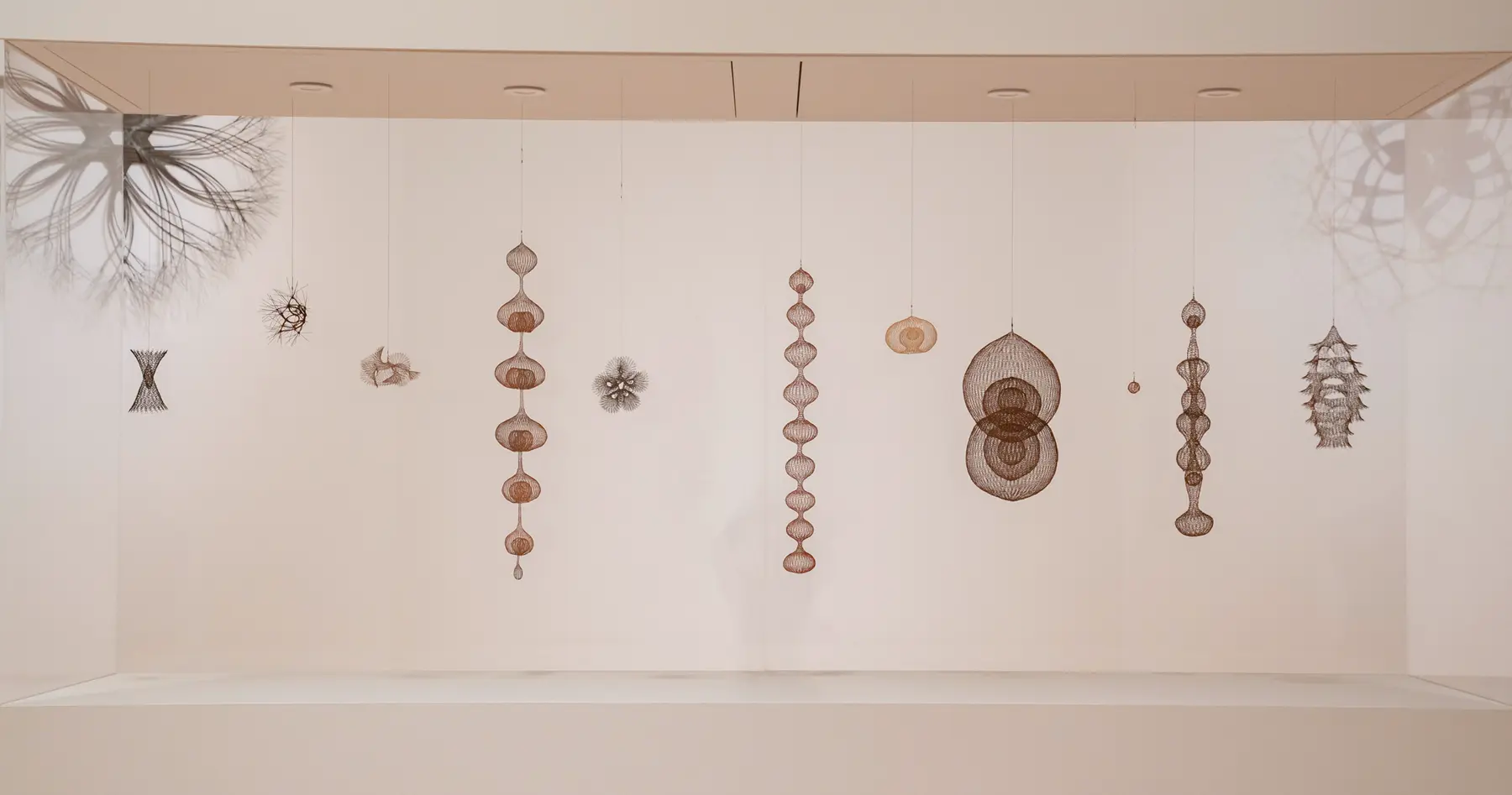
Installation view of Ruth Asawa: Retrospective at the San Francisco Museum of Modern Art, California, 2025. Photo by Adam Stanzak.
Artwork © 2025 Ruth Asawa Lanier, Inc., Courtesy David Zwirner
‘One of the things that distinguishes this show is we’re looking at every medium Asawa worked in,’ says Janet Bishop, the Thomas Weisel Family Chief Curator and Curator of Painting and Sculpture at SFMOMA, who organised the exhibition with Cara Manes, Associate Curator, Department of Painting and Sculpture, at the Museum of Modern Art in New York, where the retrospective will travel in Fall 2025. ‘We wanted to look at all aspects of Asawa’s practice, in which everything is interconnected.’
Bishop notes that Asawa’s house was the ‘epicentre’ of her creative life: she worked from a home studio but only used that space for ‘messy things.’ She preferred to be in the living room, around people, including her children. ‘She would hang sculptures in the door jamb between the living room and the kitchen,’ says Bishop, ‘and work on them either standing or in the window seat.’
Suspended looped-wire forms are emblematic of Asawa’s sculptural language. Using a versatile material that was easy to put down and pick back up, she produced baskets, spheres, cones and trumpets. She also invented a unique, multilayered form that seemed to swallow itself, that in 1952 she termed the ‘continuous form within form’.
“Asawa remained committed to seeking a full range of permutations within a set of constraints, seeming to ask, How many ways can a sphere be interlocked, a lobe layered, two cones interpenetrated?” — Cara Manes
Asawa possessed not only visual acuity but also haptic intelligence.
She believed in what you learned through using your hands. — Janet Bishop
At home, she would give her children tactile tasks to perform, like looping wire around a dowel or moulding bread dough. To design the basin for San Francisco Fountain (1970–73) in Union Square, she invited more than 200 community members to mould images of San Francisco out of dough. The images, cast together in bronze, formed an intricately textured portrait of the city.
Given the indelible mark Asawa left on the city, for Bishop, curating a posthumous retrospective of Asawa in San Francisco meant connecting with the artist’s innumerable friends, colleagues, and collaborators. ‘She was such a social and community-oriented person,’ says Bishop. ‘She touched so many people.’”
Read more from Christies: The haptic intelligence of Ruth Asawa, by Jenny Wu.
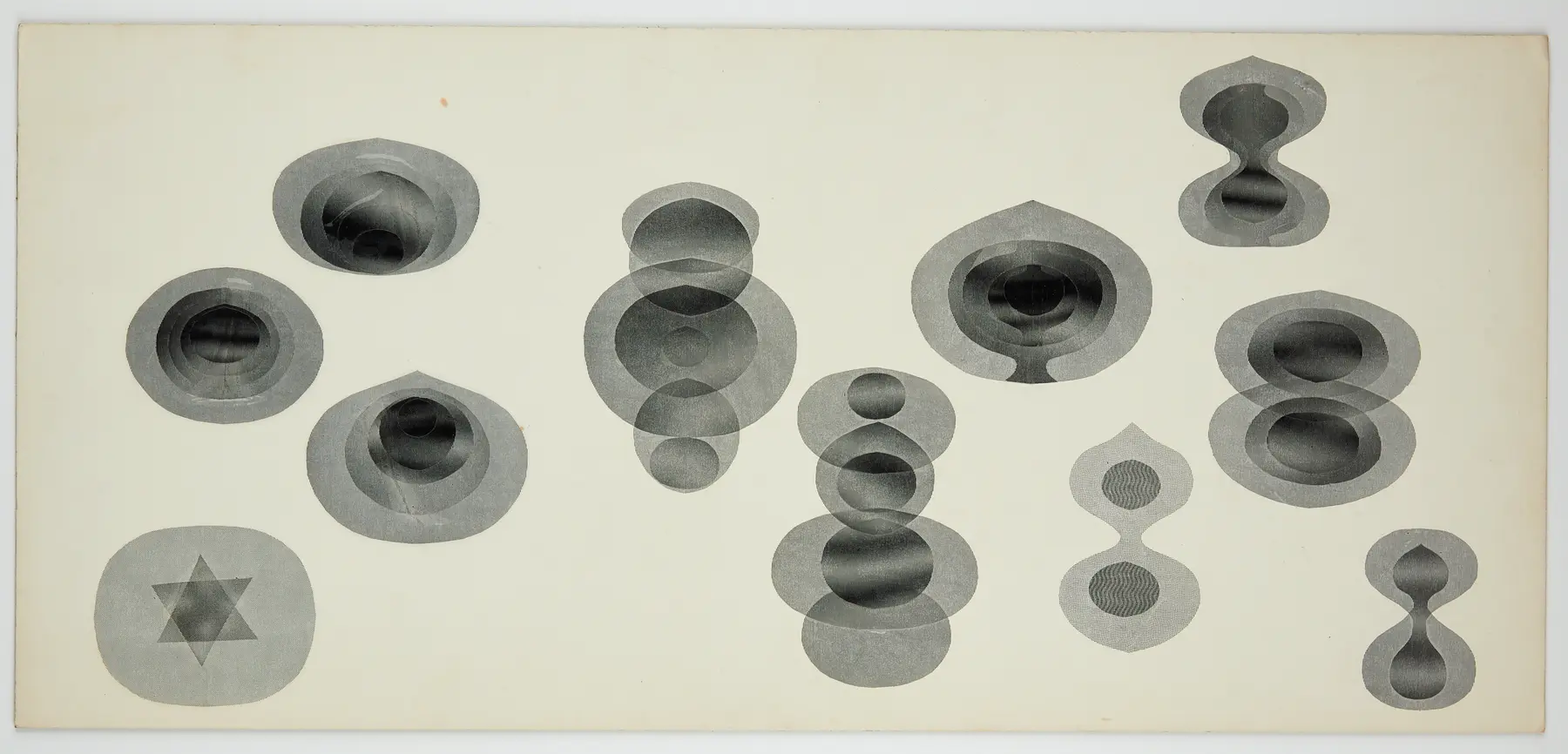
Untitled (ZP.18F, Eleven Looped-Wire Sculptural Forms), c. 1950s, Mid-Late screentone on matboard
Artwork © 2025 Ruth Asawa Lanier, Inc., Courtesy David Zwirner
“In a room designed to resemble the living room of Asawa and Lanier’s Noe Valley house, there’s a 2018 patinated bronze made from a 1976 wax cast of Asawa’s hands. Even though there are photos of Asawa at various ages throughout the show and a catalog photo of her sitting inside of one of the mesh bubbles as she works on it, it is still stunning to think of all she made with those small, strong hands. Even more stunning to realize that she made much of this work while she and Lanier, an architect, were raising six children.
My mother didn’t use the word ‘work’ very often; she really wanted us to figure out how to enjoy what you were doing, even if it was cleaning. — Aiko Cuneo
Their oldest daughter, artist Aiko Cuneo, says her mother brought friends and family and art all together in their home. “It was all the same in the house. In the kitchen, sometimes up in the bedroom. In any space in the house; there was only a studio space after 1961, but it was still in the house. It was like she would put the spaghetti pot on and work on a sculpture. Stop and start.”
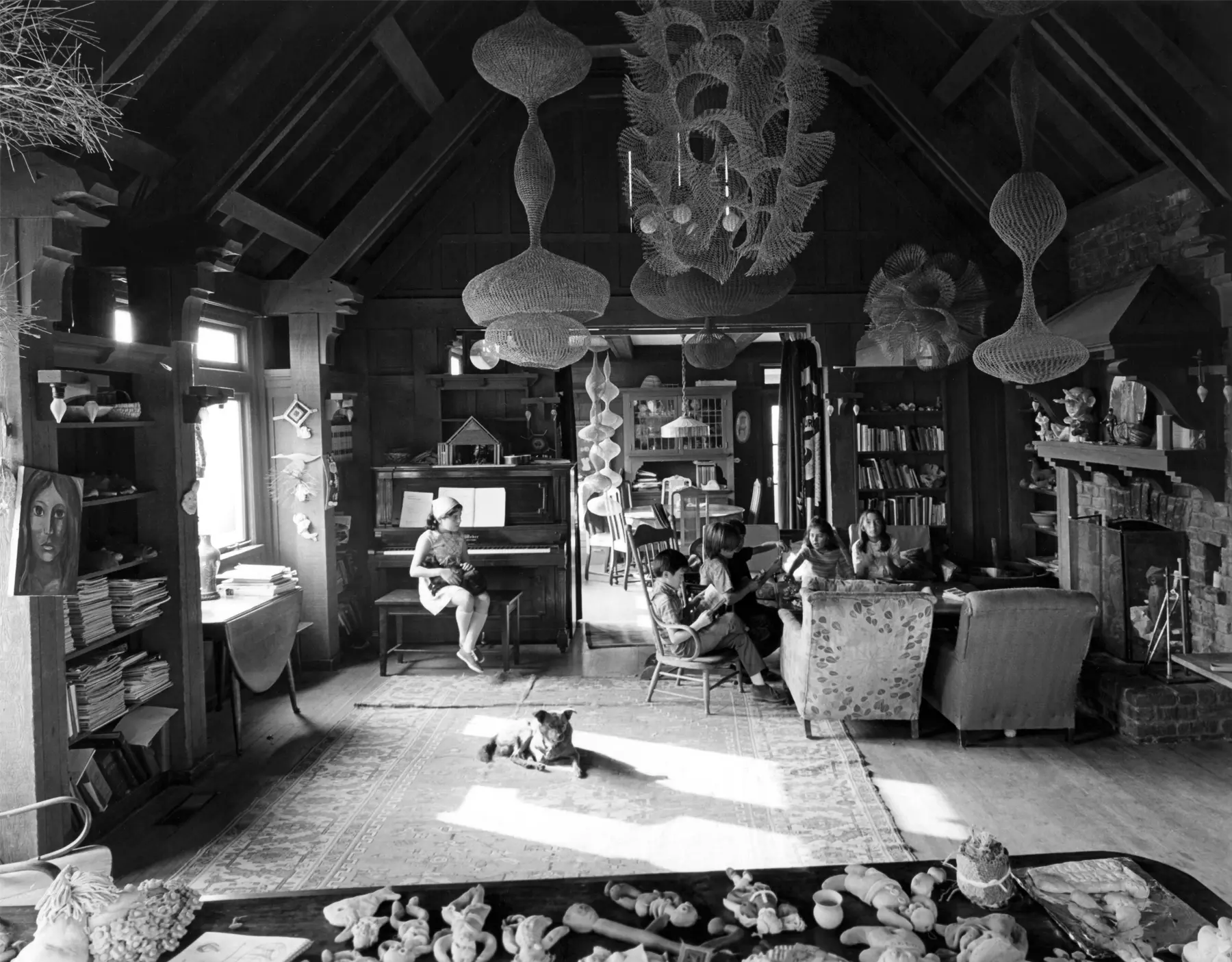
Looped-wire sculptures in the living room of Ruth Asawa’s San Francisco home, California, 1979.
Photo by Rondal Partridge. © Rondal Partridge Archives. Artwork © 2025 Ruth Asawa Lanier, Inc., Courtesy David Zwirner
When she needed uninterrupted time, Cuneo says Asawa would rise at 4 a.m. to have a few hours to herself before the kids got up. “She had this work ethic that was from her parents, who were some of the hardest-working people ever,” she says. “There were seven of them, and they were necessary to keep the truck farm, so she knew how to work hard. She enjoyed working. She taught us to cook and clean and iron and help around the house. My mother didn’t use the word ‘work’ very often; she really wanted us to figure out how to enjoy what you were doing, even if it was cleaning.”
Try something new. Don’t be afraid to fail. You know if you have an idea, you’ll eventually work that out. You have to have failure in order to get there.’ –Ruth Asawa
Watching their mother’s works in progress, the Asawa children learned that mistakes are part of creation. Cuneo says her mother told them, “’Try something new. Don’t be afraid to fail. You know if you have an idea, you’ll eventually work that out. You have to have failure in order to get there.’ I think is one of the most important life lessons she taught us.””
Read more from Mission Local: Ruth Asawa’s astonishing art at SFMOMA, by Teresa Moore.
Read The New York Times Ruth Asawa’s Astonishing Universe Began at Her Door where reporter Hilarie M. Sheets visits Asawa’s family home and interviews family members.
View a timeline of Asawa’s life >